
19 May 2026 | Blog
The article in 7 statements:
1. Material, information, and financial flows must be viewed as an integrated overall system.
2. Liquidity is a key performance factor in modern supply chains.
3. Efficiency is achieved by reducing financial friction losses along the supply chain.
4. Resilience is achieved through financial and operational synchronisation.
5. Sustainability requires financial stability.
6. The financial digital twin will become the central management tool in the future.
7. Open source is the key to interoperability and scalability.

15 April 2026 | Magazine
The first successful use cases involving implementation of the iLEAP interface for exchanging emissions data demonstrate that open standards are an essential prerequisite for sustainable logistics – and the Open Logistics Foundation is actively driving the development of iLEAP into an industry standard.

8 October 2025 | Magazine
Participation in the European market and integration into its systems are key tasks for logistics companies, both within and outside the EU. Closer cooperation between all industry stakeholders is essential to ensure continued economic growth in Europe and maintain its attractiveness to businesses.

8 October 2025 | Magazine
With the OLF-eCMR, the Open Logistics Foundation has published the first building block for 100% digital logistics. It is now up to companies to make use of the potential of the software – to increase the efficiency of their processes for new business models and applications.

2 June 2025 | Magazine
The diversity and sheer number of players in the air cargo industry make the digitalisation of the industry more difficult. Together with IATA, the Open Logistics Foundation now aims to improve access to new standards and solutions while building an open source community.
9 December 2024 | Magazine
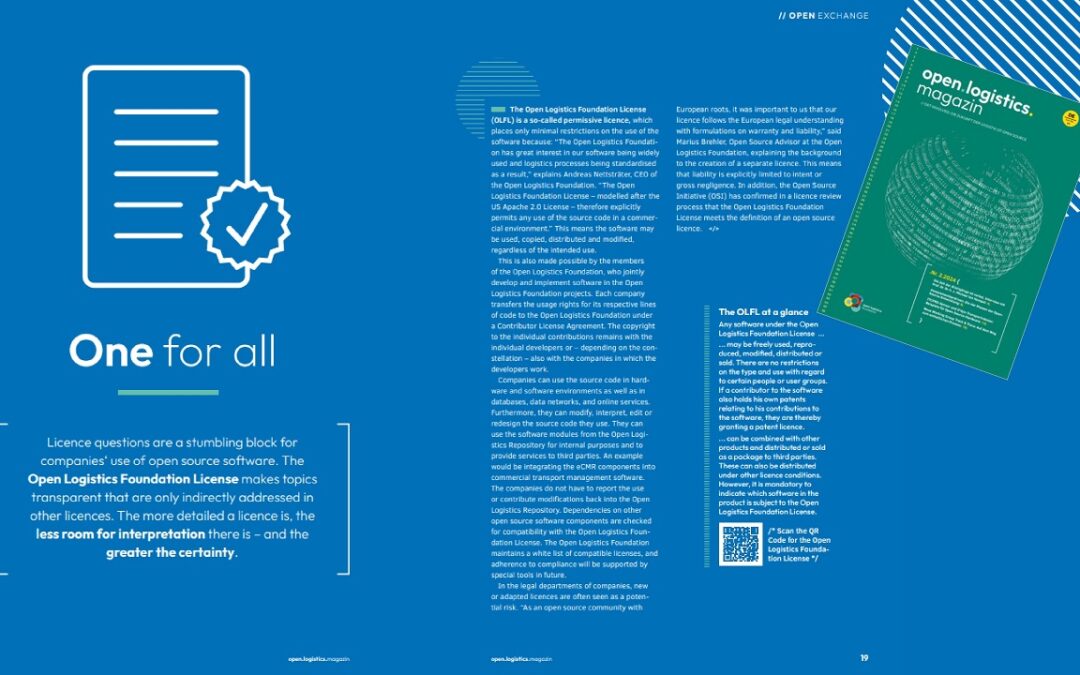
Licence questions are a stumbling block for companies’ use of open source software. The Open Logistics Foundation License makes topics transparent that are only indirectly addressed in other licences. The more detailed a licence is, the less room for interpretation there is – and the greater the certainty.
