Many companies still focus primarily on using open source: the idea that companies cannot only review, adapt and further develop the code, but also contribute their own developments back into the developer community, often takes a back seat. The importance of this exchange is currently evident in the OLF-eCMR Toolbox: by developing the components, the members of the Open Logistics Foundation have created an open foundation for logistics as a whole. By using the components – that is, integrating them into their respective systems – each company contributes to the wider dissemination of the technical foundation and thus to the emergence of an industry-wide standard for exchanging digital consignment notes.
But dissemination alone is not enough: “For open solutions to become established in the long term, they must be continuously developed,” says Andreas Nettsträter, CEO of the Open Logistics Foundation. “Companies that use open solutions should therefore also contribute to their ongoing development. It is precisely this interplay between use and participation that makes open source successful.”
The digital consignment note is representative of many other open solutions currently emerging in logistics: their long-term success depends on a community that uses them, maintains them, improves them and advances them together.
Network effects through use
As soon as new open solutions are released, the initial focus is on their use – that is, their dissemination. For example, there is considerable interest in the open solution for the digital consignment note among European companies – logistics service providers, transport platforms or IT companies, regardless of whether they’re large enterprises, SMEs or start-ups.
“Each user of an open solution reaches other market participants in turn, meaning that the shared foundation can spread throughout the industry in many different ways – and each new company makes the solution even more attractive to the next,” says Jens Leveling, Technology Advisor at the Open Logistics Foundation.
The same applies to the OLF-eCMR Toolbox. If, for example, a large logistics service provider uses the toolbox‘s components for the digital consignment note, the solution reaches its customers almost automatically. The same is true when a transport platform integrates the components from the OLF-eCMR Toolbox into its existing eCMR solution or builds a new solution on this basis.
“OPEN SOURCE IS NOT A ONE-WAY STREET: PARTICIPATION IS EXPRESSLY ENCOURAGED, NECESSARY AND FAIR.”
Carina Tüllmann, OLF
The open eCMR is then also available to its customers – logistics service providers, freight forwarders and retailers. The OLF ecosystem for the open eCMR also includes IT service providers who use consulting and support services to pave the way for companies that do not have the relevant expertise or the necessary resources to integrate open components into their system landscapes.
Jens Leveling says: “This creates network effects that ensure the open solution becomes a de facto standard, just as originally intended.” For the open source expert, the fact that applications are also emerging that no one had in mind during the original development is a sign of the model’s strength: “The OLF-eCMR Toolbox is not a finished product, but consists of various open components that each participant can use, tailored to their specific requirements. What is possible with the components is also determined where they are used – in the processes, system landscapes and business models of the companies.”
Which companies use the components from the OLF-eCMR Toolbox, and for what purposes, will become more visible in the future. The Open Logistics Foundation therefore wants to identify users of the OLF-eCMR Toolbox and present them on a dedicated landing page (see ‘with one click’ below).
The first detailed accounts of experience are already available from the logistics service providers Dachser and Rhenus. These companies are members of the Foundation. However, non-members who use the open solution can also have themselves listed online as users. The aim of the landing page is to provide an overview of the diverse ways in which the open solution is already being used and the different applications emerging from it.
With one click: Everything about the OLF-eCMR Toolbox
The landing page for the OLFeCMR Toolbox on the Open Logistics Foundation website informs potential users about the possibilities for using
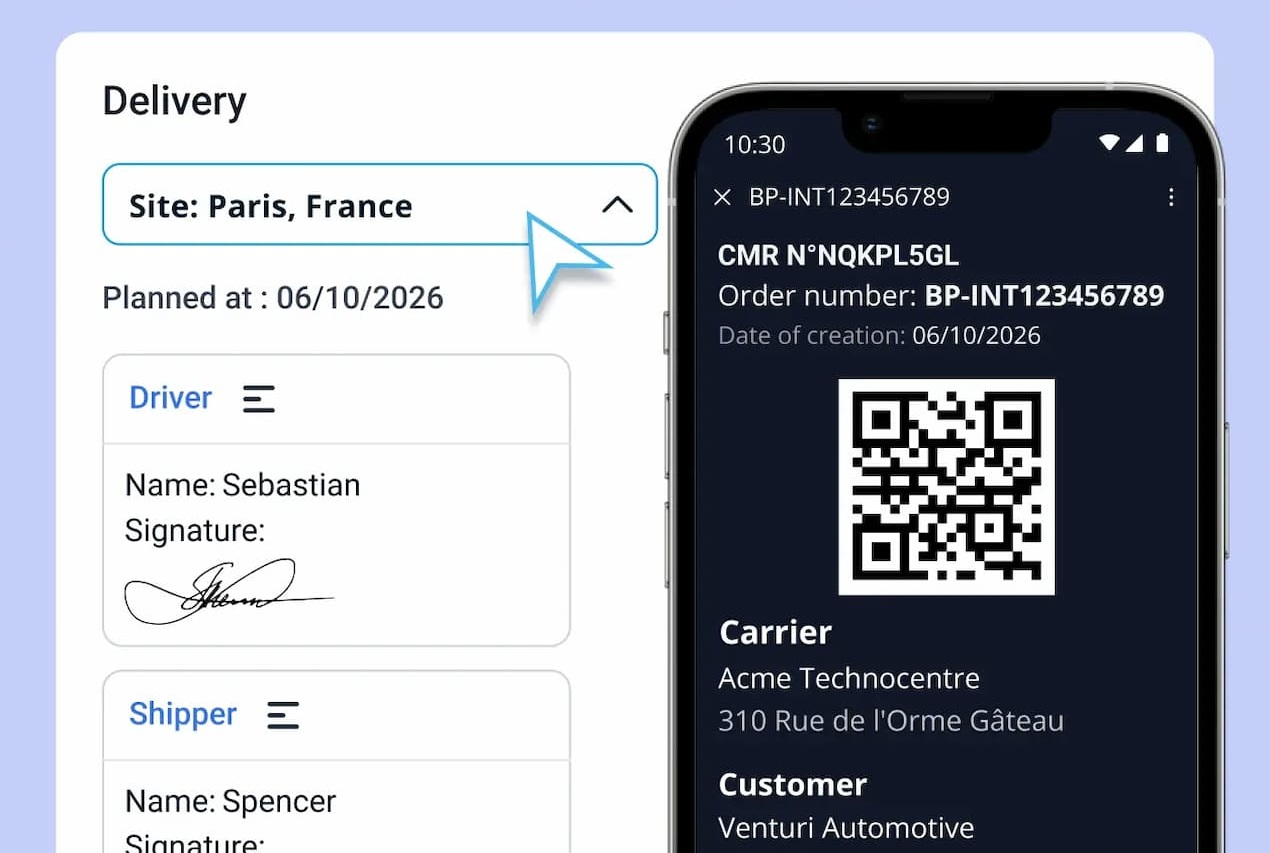
and integrating the open components. It is aimed, in particular, at companies in logistics that want to set up their own eCMR solution or are looking for a provider that has already implemented an interoperable solution based on the OLF-eCMR Toolbox. Companies with existing eCMR solutions that want to extend them with open components, thereby making them interoperable, are also addressed. The landing page also features accounts of experience with the toolbox from Dachser and Rhenus.
Better through experience
The more companies use the components, the larger the pool of experience becomes. This also reveals how well an open source solution performs under different conditions, which requirements it fulfils and where further development is needed.
“Technical quality and legal compliance are the foundation of every open solution – and, of course, this also applies to the OLF-eCMR Toolbox. However, to ensure that this remains the case after publication, it is crucial that companies feed insights back from practical experience,” says Carina Tüllmann, CCO of the OLF. User feedback and the sharing of practical experience are of great importance for the solutions’ robustness, relevance and practical usability. Carina Tüllmann says: “Even though the code is freely available and has no hidden price tag, giving something back through feedback is expressly encouraged, necessary – and fair.”
Open source expert Prof. Dr. Dirk Riehle, Professor at the University of Erlangen-Nürnberg, takes the same view. For him, user feedback is a key factor in the success of an open source community: “If a few companies develop the shared foundation while many others exclusively use it, an imbalance can arise in the long term. In open source research, this is described as the free-rider problem.”
However, users usually have their own vital interest in ensuring that the shared foundation remains high performing: those who integrate open components into their own processes and solutions ultimately benefit directly when they are further developed, adapted to new requirements and tested in practice.
“SHARING IS CARING: OPEN SOURCE THRIVES ON TURNING INDIVIDUAL EXPERIENCE INTO SHARED PROGRESS!”
Prof. Dr. Dirk Riehle, University of Erlangen-Nürnberg
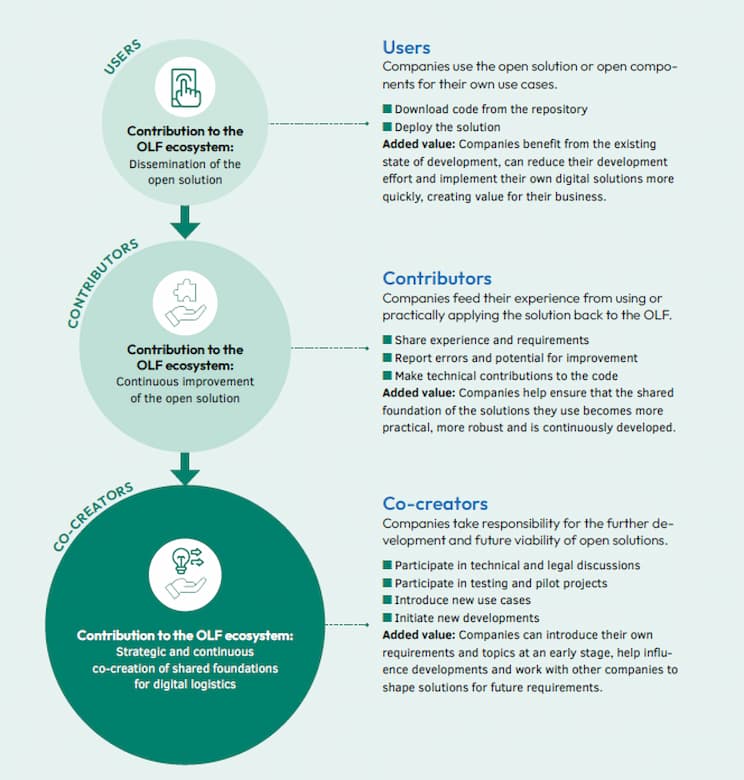
Companies can tailor their contributions to the open source components from the OLF’s Open Logistics Repository according to their capabilities and interests:
- Anyone using open components or integrating them into their own solutions can inform the OLF community directly and identify the respective use case.
- Another way to contribute is to share specific practical experience – for example, requirements, suggestions for improvement or ideas for further developing the components.
- It is particularly valuable for collaborative development when companies also contribute technically and provide code themselves. This can include their own extensions, improvements or even additional components. Such contributions are especially important because they directly develop the shared foundation further.
From feedback on individual functions and the identification of security vulnerabilities through to specific bug fixes, every contribution expands the knowledge of all participants and makes the shared foundation more robust.
Taking responsibility
Companies can also contribute in another way: they can actively help shape the development of shared foundations for digital logistics. To this end, the Open Logistics Foundation offers the opportunity to become a member of the Foundation’s Support Association, Open Logistics e. V.. Members can work in the OLF’s Working Groups and projects, discuss requirements, help determine priorities and actively shape the further development of a subject area or an open solution and its components.
“Companies therefore benefit not only from the result – the technical solution – but also from the many in-depth technical, organisational and legal discussions that precede it and bring together different perspectives and experiences. They can then use the results of this work for their own use cases or incorporate them into their own commercial solutions, which they build on the shared foundation,” explains Carina Tüllmann, highlighting the added value of participating in the OLF.
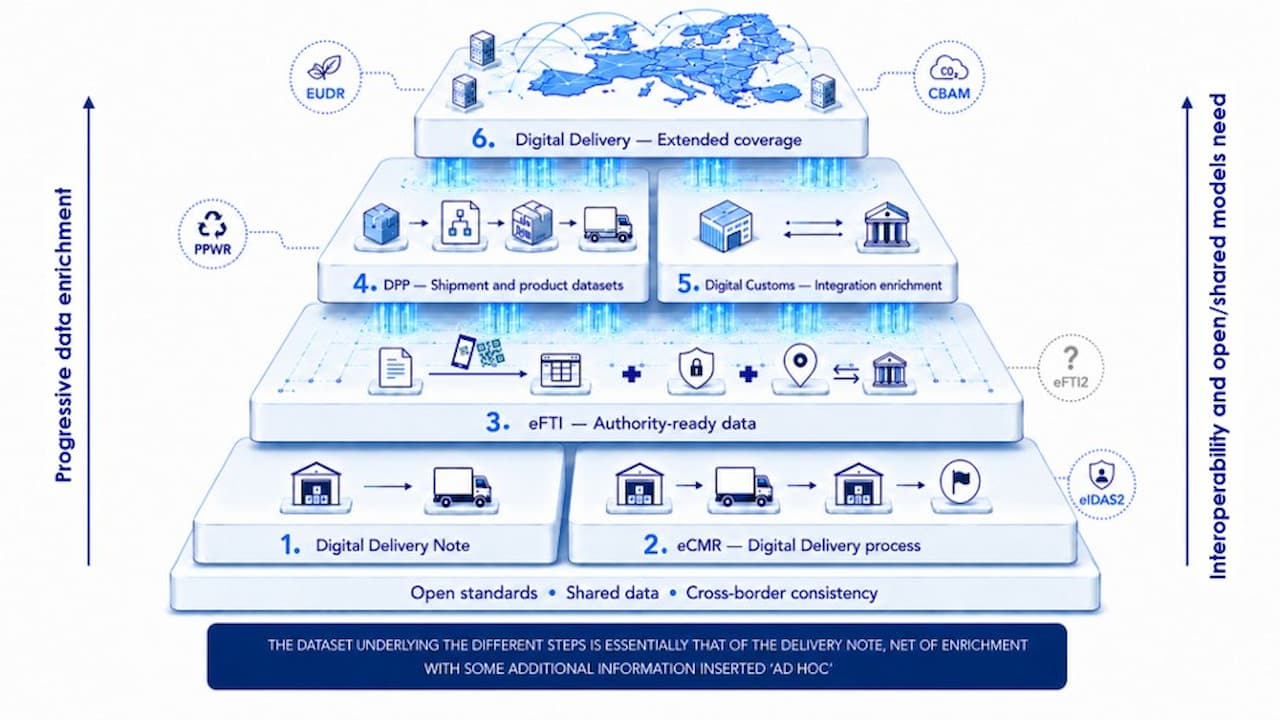
Andreas Nettsträter adds: “The need for collaborative development will likely continue to increase, particularly in relation to eCMR. As use expands across different countries and use cases, new requirements will emerge – for example, due to national regulatory requirements, different processes or specific aspects of cooperation between the parties involved. And anyone who realises how much can be achieved by working together on an open foundation may also want to apply this experience to other topics. The digitisation of further transport documents is an obvious next step, and this is already gaining momentum with our new eDeliveryNote project.”
Creating added value – from use to co-creation
Companies can advance open solutions in different ways, from using them in their own operations to actively participating in their further development.