IATA’s ONE Record, the new data and communication standard of the International Air Transport Association (IATA), is revolutionising data exchange in air cargo. Instead of exchanging information via individual messages between systems, ONE Record provides linked Logistics Objects (LO) using standardised web technologies. Provided the appropriate access rights are in place, these LOs together form a distributed dataset that can be accessed by all relevant
parties.
With NE:ONE®, a freely available server software implementation of the IATA ONE Record standard is already available in the Open Logistics Foundation’s repository. The NE:ONE Tag App supplements this technical foundation with an open-source component for the operational use of ONE Record.

Learn more about the NE:ONE project.
While information flows are becoming increasingly digital, logistics remains a physical process: shipments are loaded, packages are received, ULDs are assembled, and trucks are processed. How can the physical object be quickly and accurately linked to its digital counterpart?
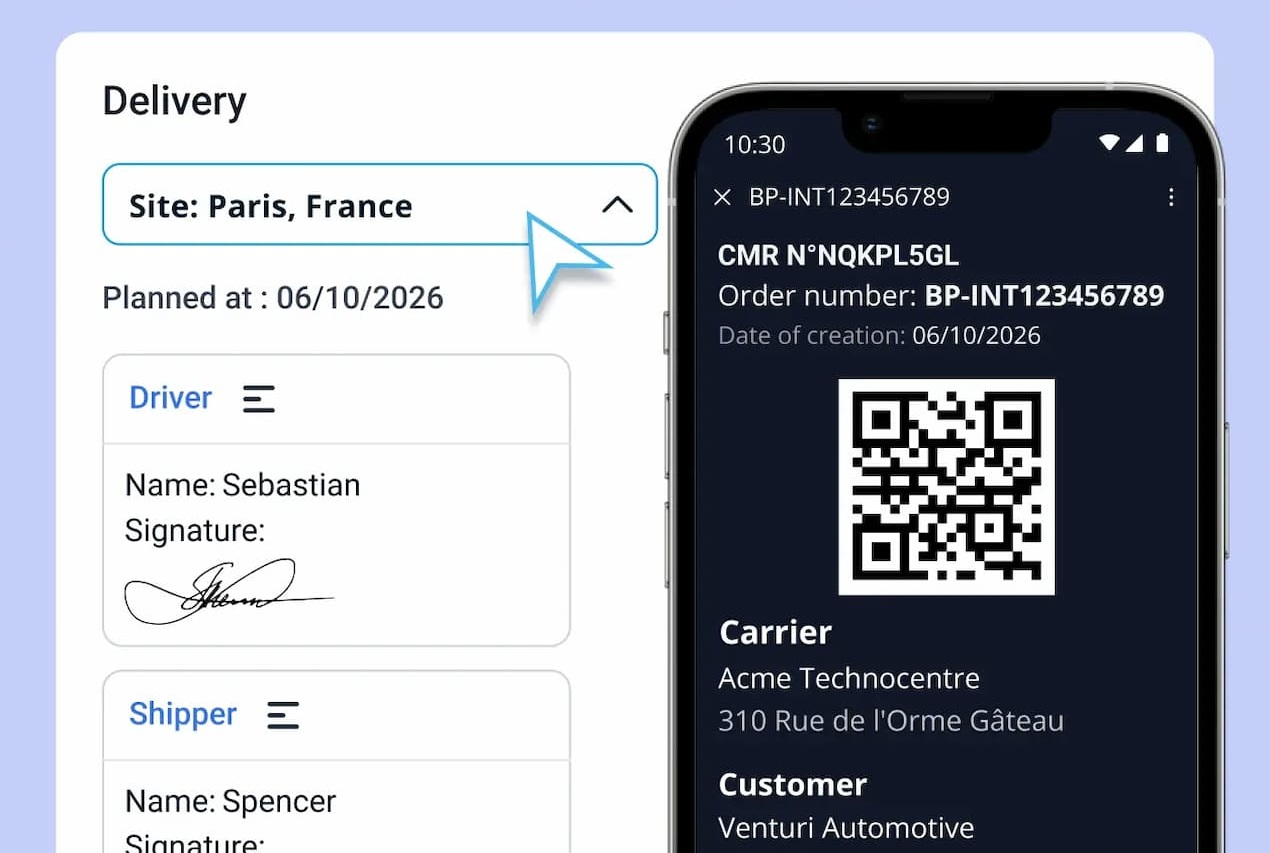
A key principle of ONE Record provides the foundation for this. Each LO is uniquely identifiablevia a Uniform Resource Identifier (URI). When this URI is attached to the physical object using a QR code, a direct link is created between the two worlds.
A package can thus refer to the corresponding Piece, a Unit Load Device (ULD) to the LoadingUnit, and a truck to the TransportMeans. Through the relationships in the ONE Record data model, a scan simultaneously provides access to additional information, such as details about the shipment, the planned transport, or packages being transported together.
This concept is now also being incorporated into existing industry standards. In the IATA Digital Cargo Working Group, the Shipment Label has been expanded to include an optional field for a ONE Record QR code. This update is currently in the final stages of approval. As a result, the link between a physical cargo item and a ONE Record could in the future be established using the established standard label.
From concept to usable tool
Tag App comes in. An initial prototype was developed during the first phase of the Digital Testbed Air Cargo (DTAC), which was funded by the Federal Ministry for Digital Transformation and Government Modernisation. Positive feedback and concrete interest from the industry led to its further development into a robust, user-oriented open-source solution.
The app is being further developed in collaboration with industry partners such as Lufthansa Cargo and Fraport. As part of a DTAC call for proposals, OLF member Business Code GmbH was selected as the implementation partner and is supporting the technical development. The NE:ONE Tag App is now established as an open source project in the Open Logistics Foundation’s repository and can be tested, customised, and integrated into companies’ own processes.
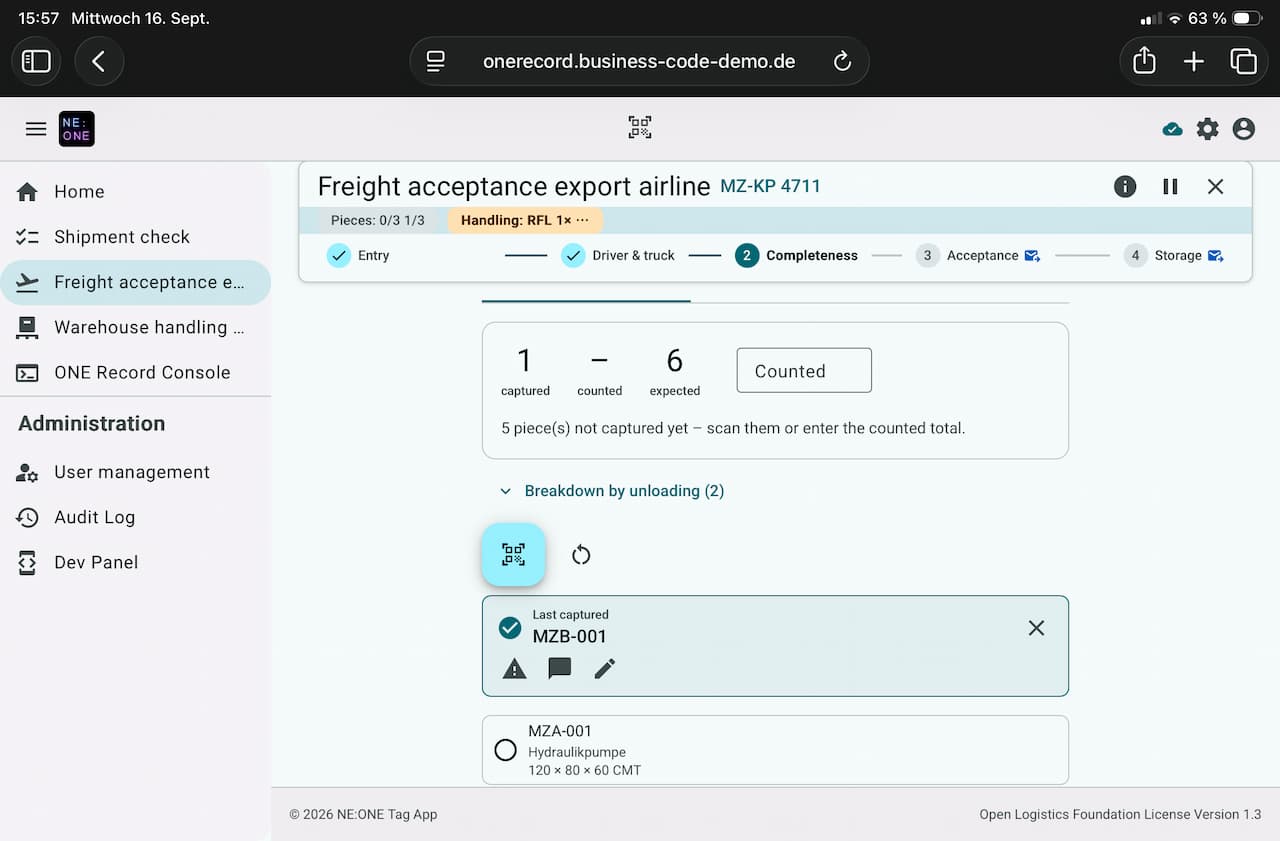
The potential becomes clear when looking at the example of an airline’s export cargo acceptance process. Today, this process often begins with cargo documents or a shipment reference. The shipment is retrieved from the relevant system, and the delivered cargo is compared with the expected information. Often, the number of packages is checked first. However, it is not immediately clear which specific package is missing.
With ONE Record and the NE:ONE Tag App, the process can begin more flexibly. For example, an employee can scan the QR code on the arriving truck. Using the associated TransportMeans and the current shipment, it is possible to determine which cargo is expected. Alternatively, the process can begin
with a single piece of cargo. Using its Piece LO and the stored relationships, it’s possible to trace which transport and which shipment it belongs to and which other packages are expected. The starting point is thus the physical object itself; the required information is derived directly from ONE Record via its relationships and reflects the current state of the data.
Next, the QR codes of the packages that are actually present are scanned. A simple count becomes a clear inventory: Not just “nine out of ten packages have arrived,” but also which nine have arrived and which one is specifically missing.
Additional information can also be recorded directly on the physical object. Damage, for example, can be documented and supplemented with photos, and a digital signature via “Sign-on-Glass” can confirm the process. The generated information is linked to the corresponding ONE Record LOs and is immediately available digitally to other stakeholders
A low-threshold entry point
As an open-source solution, the Tag App offers companies a low-threshold entry point into the operational use of ONE Record. It can be used for testing and initial use cases while also serving as a common foundation for in-house further developments, rather than having to develop basic functions individually multiple times.
The NE:ONE Tag App remains under active development. Additional screens are planned to support key process steps along the supply chain and to expand the open platform in collaboration with the community. The goal is to make ONE Record easy to use in everyday work. The app can complement
existing systems or serve as a standalone tool for operational processes. Scan a QR code, uniquely identify a physical object, and immediately access current digital information or add new information: this is how a data standard becomes a tool for the operational process.

About the author
Oliver Ditz, Project Manager and Research Associate, Fraunhofer Institute for Material Flow and Logistics IML (Fraunhofer IML), focuses on the digitalisation of air cargo. His work centres on IATA ONE Record as well as the development and testing of practical open-source solutions.
.