Contargo’s business model involves organising and carrying out container transport between seaports in Germany and the Netherlands and the European hinterland. As an intermodal operator, the company links barges, trains and trucks via a network of terminals. At these terminals, containers are handled for export and import, stored temporarily, and processed through additional services such as repairs.
The high demands of a constantly growing network
This results in a highly complex process model with numerous interfaces, such as the implementation of intelligent network control and a high degree of process automation in general. Artificial intelligence plays a key role here.
As Contargo’s business model and network structure are constantly evolving in line with its growth strategy – both geographically and strategically – a careful assessment was carried out prior to the strategic ‘Make’ decision to determine whether off-the-shelf applications available on the market could meet these requirements and be flexibly adapted to Contargo’s specific process model
Digital independence with COLA
The analysis outcome was clear: none of the available solutions met all the requirements. This gave rise to the vision of an in-house, technologically forward-looking digitalisation platform, which Contargo refers to as Contargo Open Logistics Apps (COLA). Today, it forms the basis for the gradual
automation of core intermodal processes and the further development of Contargo’s system landscape, which has evolved over time.
The aim is to deliver tangible operational benefits. These include, for example, shorter processing times at terminals, more efficient handling of customer orders and invoices, and reduced repetitive manual tasks for staff. All of this contributes to improving service quality both internally and for customers.
In its development work, Contargo relies on modern software technologies based on open source. In addition, Contargo develops numerous IoT components in-house. This is driven by the strategic aim of digital independence. Contargo wants to design and further develop the digital processes crucial to its business model as much as possible itself.
IoT from in-house production
COLA is not only gradually replacing legacy systems but also integrating the digital platform with in-house developed technical solutions. These include, for example, OCR gates and check-in kiosks.
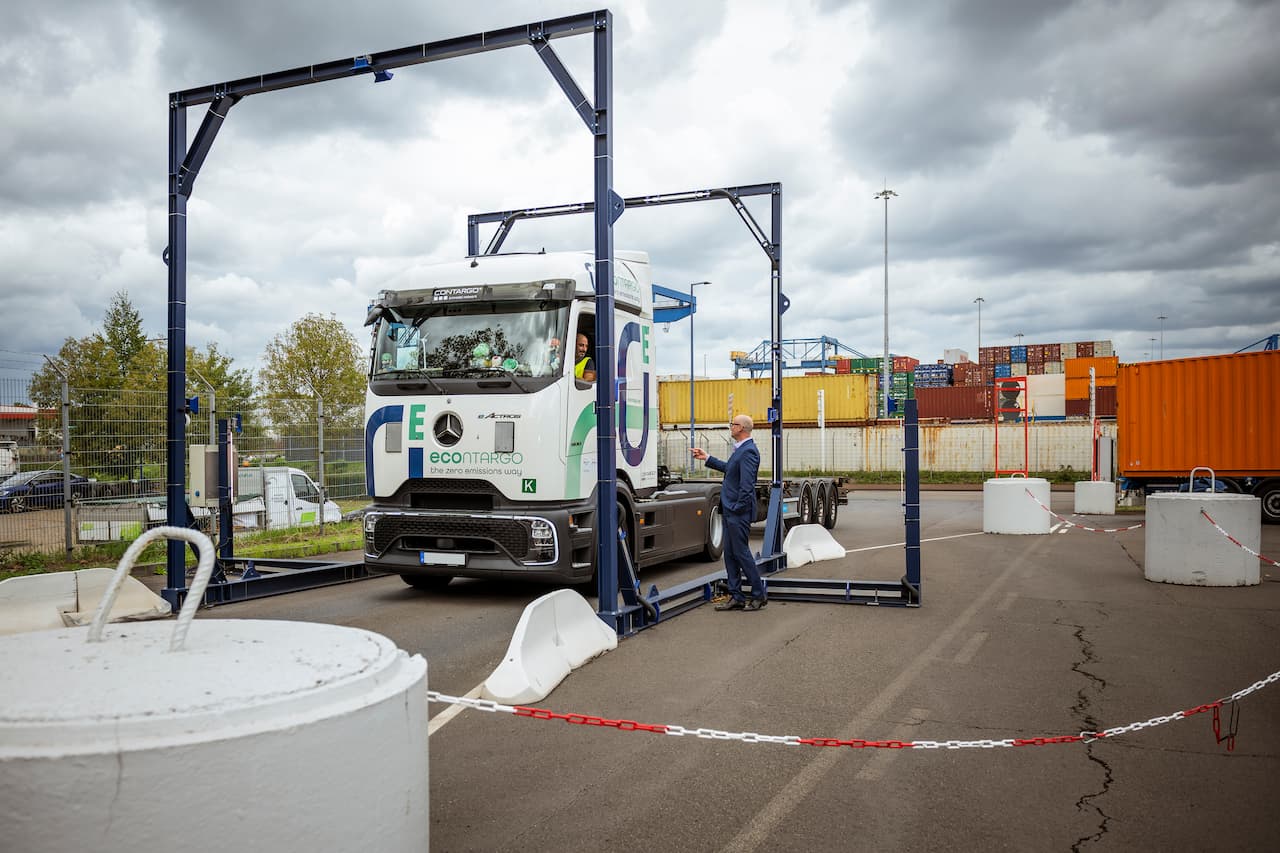
Contargo has developed OCR (Optical Character Recognition) solutions tailored to its own terminals. When a lorry passes through the gate, lights, cameras and other sensors automatically capture key information – such as truck registration numbers, container numbers, dangerous goods labels, ISO codes, etc. – in real time. At the same time, the system documents and records any container damage and other anomalies.
Automation also assists with the outbound process. The system checks whether the correct container has been loaded onto the designated truck. The system detects incorrect loadings immediately and directs the truck to the clearance area at the terminal. The automated dangerous goods label check further reduces manual steps.
Contargo has also developed the check-in kiosks itself. At the drive-by kiosks, drivers who have registered digitally in advance and present their digital driver ID cards to receive a receipt upon entry containing the collection or delivery instructions. Drivers who have not registered in advance can register at the walk-by kiosk. Further stages of development in this area include digital driver ID cards stored in digital wallets, enabling paperless operations.
Developing such solutions involves more than just the software. Contargo also develops and integrates the appropriate hardware, such as robust scanners, solutions for easy paper changes, and network connectivity.
Another example is the geolocation of reach stackers. The power supply, cabling, the integration of GNSS and OCR modules, and the stable network connection to the Contargo network are all in-house solutions.
Digitalisation is also change management
A transformation on this scale is not merely a technological challenge. It alters processes, roles and ways of working, and is therefore always a change project as well.
A key factor for success is close collaboration between IT and the operational side of the business. Contargo does not view digitalisation as a purely IT project. The focus is on determining which processes the company will need in the future and how digital means can support them effectively. The operational side of the business develops these processes.
At its core, this is not merely about replacing processes that have evolved over time with a modern TMS platform. Over the years, customers, sites and staff
have shaped processes for good reasons and have become accustomed to them. Replacing legacy systems and introducing modern ones offers the opportunity to critically examine existing processes, standardise them, and rethink them in a digital context. Involving staff in this process is crucial. Experience shows that everyone affected by the change must be involved through direct participation and engagement, thorough information, and substantive discussion.
Contargo’s digital transformation is also accompanied by a second change. The evolution from an organisation that has developed over time, characterised by individual, independent companies operating and taking responsibility on their own, towards a more closely networked organisation, with collaborative
working across regions and within the network.
An ageing and heterogeneous application landscape – built up over time, particularly through acquisitions – is being gradually replaced by COLA. As a result, the digitalisation platform itself becomes a tool for organisational transformation. Good processes can be enhanced digitally, whilst outdated workflows can be replaced by new, standardised processes. This creates a digital foundation for the most extensive and consistent process standardisation possible across the network.
“OPEN SOURCE IS A TOOL FOR ENSURING LONG-TERM INDEPENDENCE FROM EXTERNAL PROVIDERS.”
Gerd Schmidt, Contargo
Open source in the commodity-IT environment
A further challenge is that Contargo’s IT, which is part of the Rhenus Group, is also embedded within the Group’s IT structures. This means that Contargo implements groupwide IT standards – for example, in IT infrastructure and IT security – whilst at the same time pursuing an open source approach with COLA. Practical experience shows that open source software and in-house solutions can coexist with standardised infrastructure and security requirements. For example, specific security systems from the Rhenus Group are integrated into the COLA team’s agile software development process.
Open source as a strategic building block
With its ‘Make’ strategy, Contargo is pursuing a long-term approach: the digitalisation of its core processes should not depend solely on external software providers and their product roadmaps. The company does not view in-house developments, open source and commodity IT as mutually exclusive, but rather as different building blocks of an overall digital strategy. Open source plays a particularly important role in this context. Open solutions make it possible to further develop software independently of individual providers, adapt it to changing requirements and share knowledge with other stakeholders. A collaborative approach is particularly well-suited to the logistics sector. Common standards and jointly developed software can prevent duplication of development efforts and accelerate innovation.
Contargo’s membership in the Open Logistics Foundation was therefore a logical step. The company recently released containerLib – the first, albeit small, software artefact from the COLA development programme – as open source. This Java library, developed in-house, enables the standardised processing of container numbers and truck registration numbers. Other companies are free to use it, integrate it into existing applications and collaborate on its further development.
However, the real strength of this approach lies one level higher. For Contargo, digital independence means being able to shape the digital support for the company’s own business model ourselves where it is strategically relevant, without depending on external tech companies and software providers for licensing.
In this context, open source is a tool for securing this independence in the long term, combined with commodity IT, group-wide standards, and an organisation prepared to continuously develop its processes and working methods.
About the author
Dipl.-Wirt.-Ing. Gerd Schmidt has been with the Contargo Group, a subsidiary of the
Rhenus Group, since 2021. As Head of IT at Contargo, he is responsible for infrastructure, IoT manufacturing, automation, software development and application management, IT support, data integration, IT rollouts, and IT projects. In addition, Gerd Schmidt also sits on the IT Board and the IT Application Board of the Rhenus Group.
.