European regulatory forces are converging, increasing the structured information exchanged along supply chains. The first comes from the need for more sustainable, resilient and transparent supply chains. CSRD [7] and CSDDD [8] increase demand for reliable value-chain information, while EUDR [5] and CBAM [6] introduce specific traceability and reporting requirements. Although they do not all govern delivery documents directly, they require stronger links between operational flows and product, supplier and shipment data.
A second force comes from Europe’s digital policy. The Digital Decade Programme [12] and Single Digital Gateway [13] promote harmonised digital interactions across EU countries, particularly with public administrations.
A third force is the EU Customs Union reform. The agreed Union Customs Code [3] will establish an EU Customs Authority and Data Hub. Together with the EU Single Window Environment [4], it aims to simplify submission, reuse data and reduce fragmentation.
A fourth force is fiscal. ViDA [11] supports e-invoicing and digital reporting for intra-EU transactions, increasing structured data exchange.
A fifth force seeks to reduce paper, speed up controls and replace inefficient manual processes with digital tools.
A sixth force is the focus on interoperability. The Interoperable Europe Act [16], although focused primarily on public services, promotes shared standards, reusable solutions and, where appropriate, open-source components. The wider lesson is that interoperability depends on rules and processes consistently applied by different actors.
Open collaboration: building a shared basis to support regulation
These regulations share groundwork: defining datasets, mapping them onto internal systems, connecting actors and aligning implementations. Repeating much of this work independently creates no competitive advantage. The first answer is not necessarily open-source software, but open collaboration around standards, data models, interfaces and process rules. Standards provide a common language; interoperability enables its consistent use across organisations and systems. Open source software may implement parts of this shared foundation, but is not the primary objective. Nor do these foundations automatically accelerate adoption.
In practice, voluntary convergence between businesses is often slow, fragmented and constrained by bilateral interests. Their value lies elsewhere: when standards and process models result from sound, open and collaborative work, they provide a credible and mature basis for future regulation.
The logistics sector offers a practical example. The Open Logistics Foundation has developed an open source eCMR implementation [17], while an IRU initiative highlights the need for interoperability between providers [14]. Electronic invoicing follows a similar path: common specifications enable different networks and market solutions to exchange information reliably. Interoperability cannot simply be purchased: it depends on agreements that multiple actors recognise and maintain. Technically sound, genuinely collaborative communities and standardisation groups can develop credible, reusable solutions supporting broader institutional adoption. In our experience, this changes methods before technology. Delivery integration has traditionally relied on bilateral connections; overlapping European regulations risk multiplying each new obligation across these links. Supply-chain standardisation has always been central to TESISQUARE. Communities like the Open Logistics Foundation bring different experiences together to combine standards, interoperability and process governance for broader, more consistent adoption.

Learn more about the OLF-eCMR Toolbox.
Tools for the digital transition
Tools addressing the six forces operate at different levels on shared foundations. In countries adhering to the Additional Protocol, eCMR [2, 14] gives electronic consignment notes the same legal function as paper ones. Effective cross-border use requires common data models and interoperable solutions. From 9 July 2027, eFTI [1] requires EU authorities to accept regulatory freight information from certified platforms. Common datasets, access procedures and certification rules enable platforms and authority systems to interact. The Ecodesign for Sustainable Products Regulation [18] provides the Digital
Product Passport framework. PPWR [9] complements it for packaging with harmonised labelling, QR codes and other open digital data carriers. eIDAS2 [10] provides a shared identity, signature and trust-services framework for secure cross-border processes. Digital Customs [3, 4] promotes structured, reusable, centrally accessible data. These tools require collaboratively implemented agreements, not just product purchases.
The transformation path for businesses
For businesses, these regulations define a transformation path, not a single compliance requirement. Addressing it early can affect both benefits and complexity. Evidence from several European countries [14, 15] points to faster access to Proof of Delivery, fewer document-related disputes and less
administrative work. These benefits depend on network-wide adoption. An early roadmap, based on existing and reasonably foreseeable constraints, helps manage organisational and technological change and reduce adaptation costs. Unfortunately, spontaneous business adoption is almost always too slow to deliver full system-wide benefits. A stable, interoperable process framework offers a credible basis for broader adoption. The following roadmap translates these requirements into a structured path.
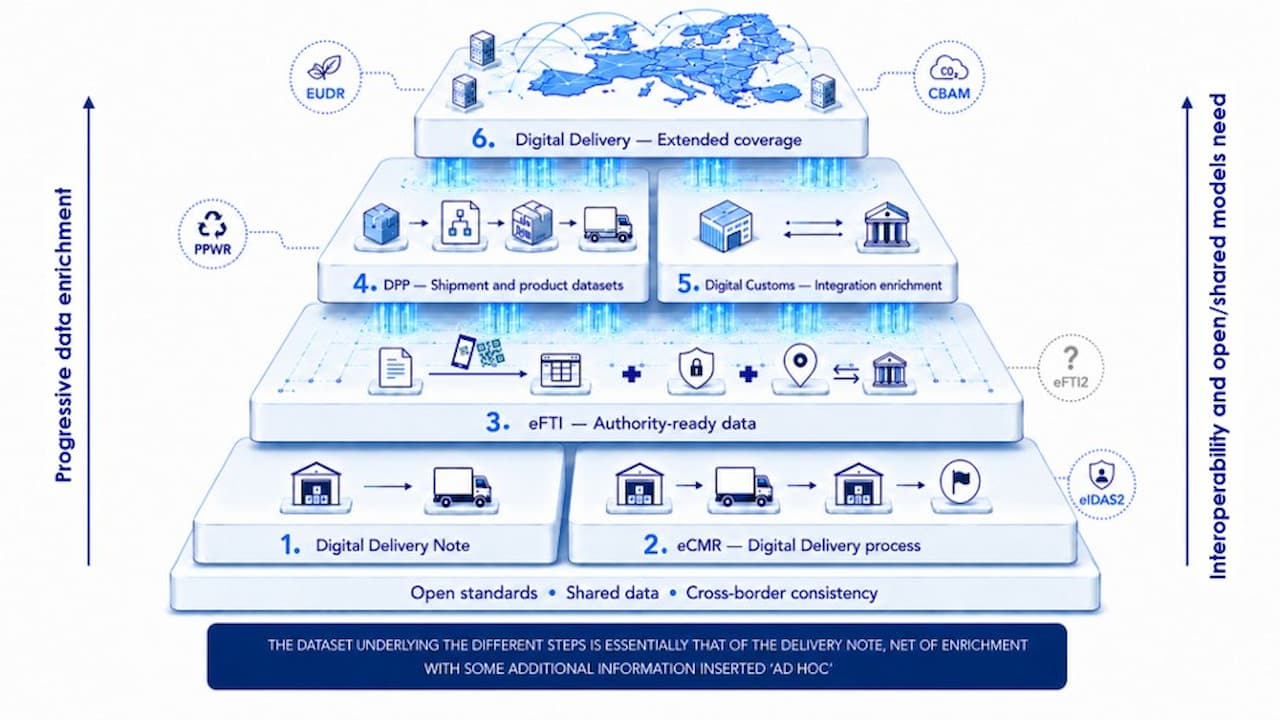
A possible 6-stage roadmap for road transport delivery processes
Road transport delivery can be digitalised in six successive stages.
- The first digitalises the Delivery Note in its various EU forms.
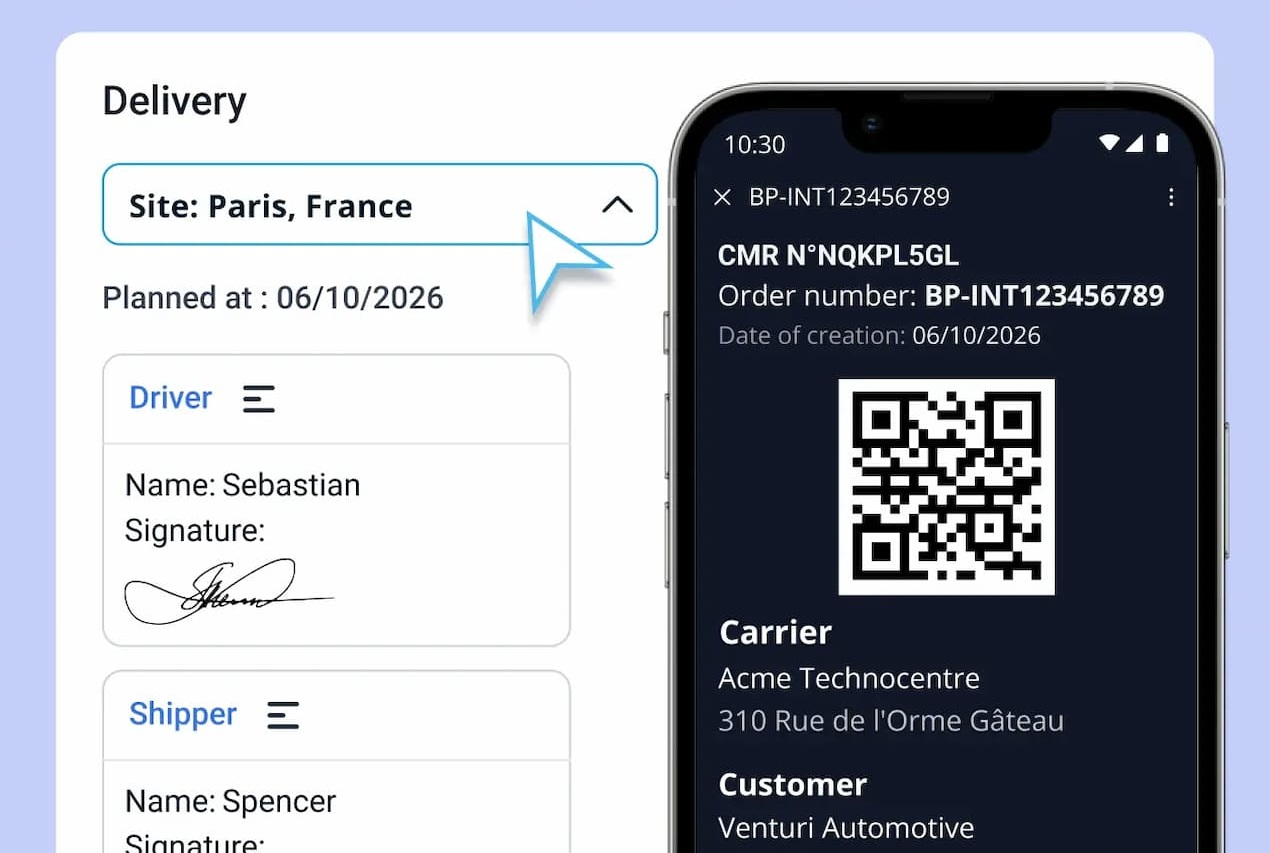
- The second follows the eCMR protocol [2, 14], covering not just a document but the delivery information flow: the Delivery Note, traceability of responsibilities, evidence of critical events and Proof of Delivery. The goal is a complete digital process with basic collaboration.
- The third connects digital Delivery Note or eCMR data to eFTI mechanisms [1], making it accessible to control authorities.
- The fourth links each shipment to relevant product and packaging datasets. Digital Product Passports under the ESPR [18] and digital information mechanisms under the PPWR [9] support structured supplier–customer data exchange, including import/ export processes.
- The fifth adds any required customs information accompanying the goods, in line with Digital Customs developments [3, 4].
- The sixth progressively expands information exchange, ensuring continuity and consistency within a paperless Digital Delivery model aligned with the expected evolution of EU regulation.
Success depends on integrated adoption of open standards, effective interoperability tools, and regulatory and procedural consistency across Europe. Regulatory convergence around a collaboratively developed Digital Delivery framework can help bring different needs together and provide a common direction, potentially making full use of the regulatory wave. The road remains long, but the opportunity to create efficiency and simplification has never been so close.

About the authors
Paolo A. Catti is an Adjunct Professor of Supply Chain Management and Director of the Master in AI-Driven Business Models at Università Cattolica del Sacro Cuore in Milan. His work focuses on digital transformation and supply chain digitalisation.
Gianmario Mollea is a Product Manager at TESISQUARE. He helps companies through their digital transformation journeys and is deeply committed to leveraging interoperable frameworks and digital standards to build seamless, efficient, and sustainable logistics networks across Europe.
.
References
[1] Regulation (EU) 2020/1056 on eFTI. https://eur-lex.europa.eu/eli/reg/2020/1056/oj/eng
[2] Additional Protocol to the CMR concerning the Electronic Consignment Note, 2008. https://unece.org/DAM/trans/conventn/e-CMRe.pdf
[3] Council of the EU, Modernising the EU Customs union, 3 Sept. 2026. https://www.consilium.europa.eu/en/policies/modernising-the-eu-customs-union/
[4] Regulation (EU) 2022/2399, EU Single Window Environment for Customs. https://eur-lex.europa.eu/eli/reg/2022/2399/oj/eng
[5] Regulation (EU) 2023/1115 on deforestation-free products. https://eur-lex.europa.eu/eli/reg/2023/1115/oj/eng
[6] Regulation (EU) 2023/956 establishing CBAM. https://eur-lex.europa.eu/eli/reg/2023/956/oj/eng
[7] Directive (EU) 2022/2464 on corporate sustainability reporting. https://eur-lex.europa.eu/eli/dir/2022/2464/oj/eng
[8] Directive (EU) 2024/1760 on corporate sustainability due diligence. https://eur-lex.europa.eu/eli/dir/2024/1760/oj/eng
[9] Regulation (EU) 2025/40 on packaging and packaging waste. https://eur-lex.europa.eu/eli/reg/2025/40/oj/eng
[10] Regulation (EU) 2024/1183, European Digital Identity Framework. https://eur-lex.europa.eu/eli/reg/2024/1183/oj/eng
[11] Directive (EU) 2025/516, on ViDA. https://eur-lex.europa.eu/eli/dir/2025/516/oj/eng
[12] Decision (EU) 2022/2481, Digital Decade Policy Programme 2030. https://eur-lex.europa.eu/eli/dec/2022/2481/oj/eng
[13] Regulation (EU) 2018/1724 establishing a Single Digital Gateway. https://eur-lex.europa.eu/eli/reg/2018/1724/oj/eng
[14] IRU, “Paperless freight: vendors and experts eye new eCMR interoperability plan”, 2026. https://www.iru.org/news-resources/newsroom/paperless-freight-vendors-and-experts-eye-new-eCMR-interoperability-plan
[15] UNECE, Executive Guide on eCMR, Oct. 2023. https://unece.org/trade/documents/2023/10/executive-guide-e-cmr
[16] Regulation (EU) 2024/903, Interoperable Europe Act. https://eur-lex.europa.eu/eli/reg/2024/903/oj/eng
[17] Open Logistics Foundation, “First industry-ready eCMR software”, 2 June 2025. https://openlogisticsfoundation.org/open-logistics-foundation-presents-first-industry-ready-ecmr-software-at-transport-logistic-2025/
[18] Regulation (EU) 2024/1781 on ecodesign requirements for sustainable products. https://eur-lex.europa.eu/eli/reg/2024/1781/oj/eng