
The OLF-eCMR Toolbox in live operation at DACHSER SE
Motivation
DACHSER is participating in the eCMR project because digital transport documents are an effective means of reducing breaks between paper-based and digital processes, manual post-processing, paper handling and delays in the supply chain. In particular, the European road logistics network generates high volumes of documents every day: more than 6,000 international and domestic scheduled services and over 4,500 charter journeys per day demonstrate the potential for digital documents. DACHSER contributes extensive operational expertise to the eCMR project, along with requirements from European groupage and charter business and experience in integrating digital transport documents into existing IT and driver workflows.
Developments arising from the eCMR project are strategically relevant for DACHSER because they are based on an open, interoperable approach. They can therefore not only digitalise individual business processes but also enable industry-wide connectivity between shippers, logistics service providers, platforms, drivers and consignees.
Operationally, DACHSER aims to generate eCMR data from existing transport and route planning processes and make the document status available to all parties involved to significantly speed up the return of signed documents.
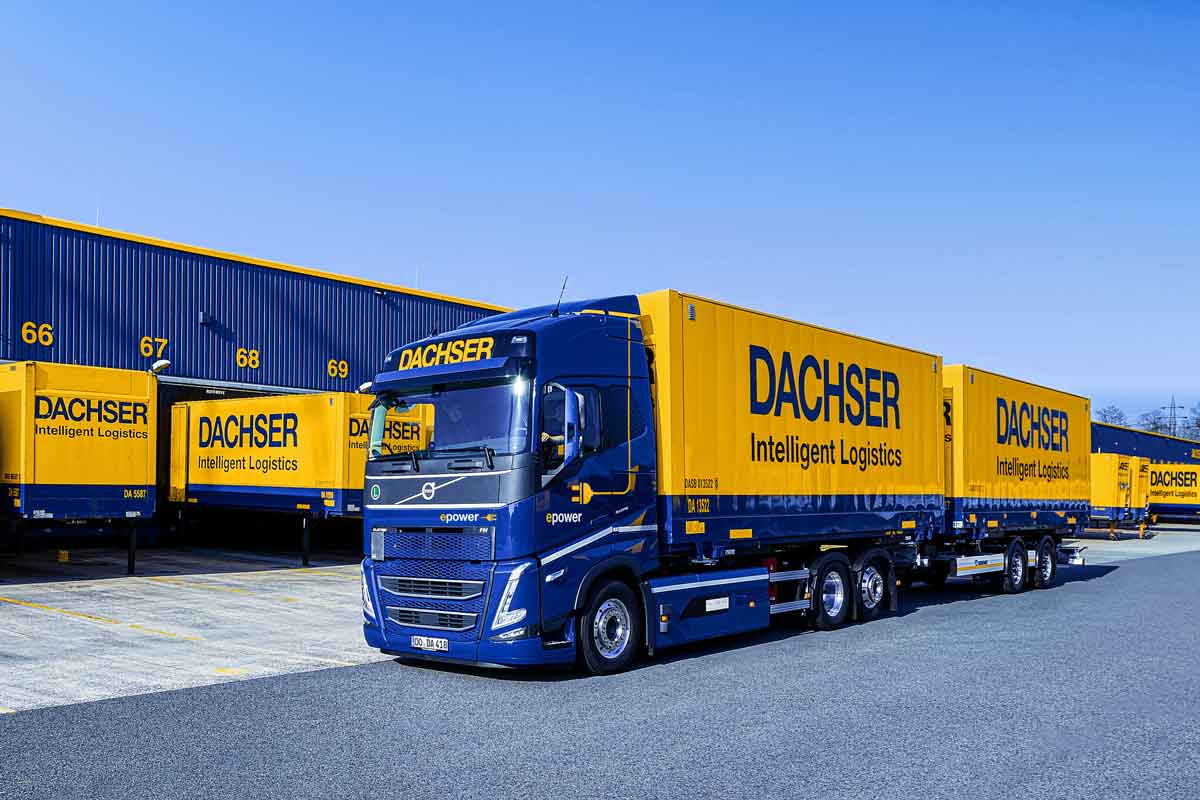
Current status and implementation experience
Building on developments within the Open Logistics Foundation’s eCMR project, DACHSER has set up its own instance and is using this as a basis for pilot schemes, integration work and gradual development of near-production or full-scale production usage scenarios. The focus is on both the manual creation of eCMRs using templates and, at a later stage, on their automated generation from existing transport and route data. In parallel, DACHSER is further developing roles and access rights, sealing/signature processes, external user access, interfaces to TMS/driver processes, and the exchange of data between multiple eCMR instances.
Use case 1 – Scheduled services
Scheduled services between DACHSER branches are considered a particularly suitable use case for scaling, as they involve highly standardised processes. Pre-prepared eCMR templates can reduce the amount of manual work required; ideally, only variable transport data such as weight, vehicle or consignment details need to be added. Routes operated by DACHSER drivers using mobile devices are of particular interest, as signature and seal processes can be carried out directly via company-issued devices. Examples under discussion include BEV routes such as Malsch-Regensdorf and Dortmund-Zevenaar.
Use case 2 – Customer and country requirements, including Spain
From October 2026, road transport in Spain will only be permitted with the electronic Documento de Control Administrativo (DeCA). Carriers from other European countries may use the electronic consignment note (eCMR) as an alternative. DACHSER is therefore developing concepts to utilise collection information from dispatch, route, and vehicle records, as well as subsequent shipment data, in such a way that digital transport documents can be generated at an early stage, assigned to a vehicle and displayed together during inspections. This involves addressing key issues relating to data quality, updating existing eCMRs, driver access, external access, and integration into driver/communication solutions such as SAM or ZeKju.
Use case 3 – further pilot candidates
In addition, further potential pilot projects have been identified, such as with interested customers, warehouse replenishment from the Netherlands to Erlensee, and FTL or shuttle scenarios in the Czech Republic, e.g., in the context of daily customer traffic. These cases are suitable for testing different operating models: manual creation using templates, external user access, ‘sign-on-glass’ at the recipient’s premises, driver access via smartphone, and, in the future, federated exchange between multiple eCMR instances.
”The Open Logistics Foundation’s solution for the digital consignment note demonstrates how open source can be put to practical use in logistics: we are not developing an isolated, stand-alone solution, but rather an interoperable foundation that is jointly supported by many companies and validated in real-world processes. For DACHSER, this is an important step towards implementing digital transport documents in a sustainable and scalable manner.“
Overall assessment
Experience to date confirms that the solution developed by companies as part of the Open Logistics Foundation’s eCMR project is a practical building block for DACHSER in the digitalisation of transport documents. The greatest added value lies not merely in replacing paper documents, but in the shared, interoperable database for all parties involved throughout the transport process.
- Advantages: reduced paperwork and archiving workload, faster document processing, fewer manual entries, better data quality, greater transparency, and access to the current document status at any time.
- Added value: The open OLF approach avoids siloed solutions and creates a foundation on which different platforms, logistics service providers, shippers and consignees remain compatible with one another. eCMR can therefore not only to improve internal processes but also to simplify collaboration across organisational boundaries.
- Lessons learned: A successful eCMR implementation requires not only the technical infrastructure but, above all, clear process definitions, robust role and authorisation models, clean data sources, straightforward access for drivers and consignees, and close coordination with customers, partners and legal/compliance experts. Standardised use cases with recurring transport patterns are particularly valuable, as they enable a quick start and subsequent scaling.
Contact
Ingo Müller
Department Head Prototyping & Testing, Corporate Research & Development
DACHSER SE
Head Office, Thomas-Dachser-Str. 2, 87439 Kempten, Germany
Tel.: +49 831 5916 0
E-Mail: info@dachser.com
DACHSER SE at a glance
- Head Office: Thomas-Dachser-Straße 2, 87439 Kempten
- Industry role: Logistics service provider with its own transport and warehouse management systems, network of operational sites, and digital customer and partner processes (DACHSER platform)
- Number of employees: 37.500 employees worldwide
- OLF membership: Founding member of the Open Logistics Foundation since 2021