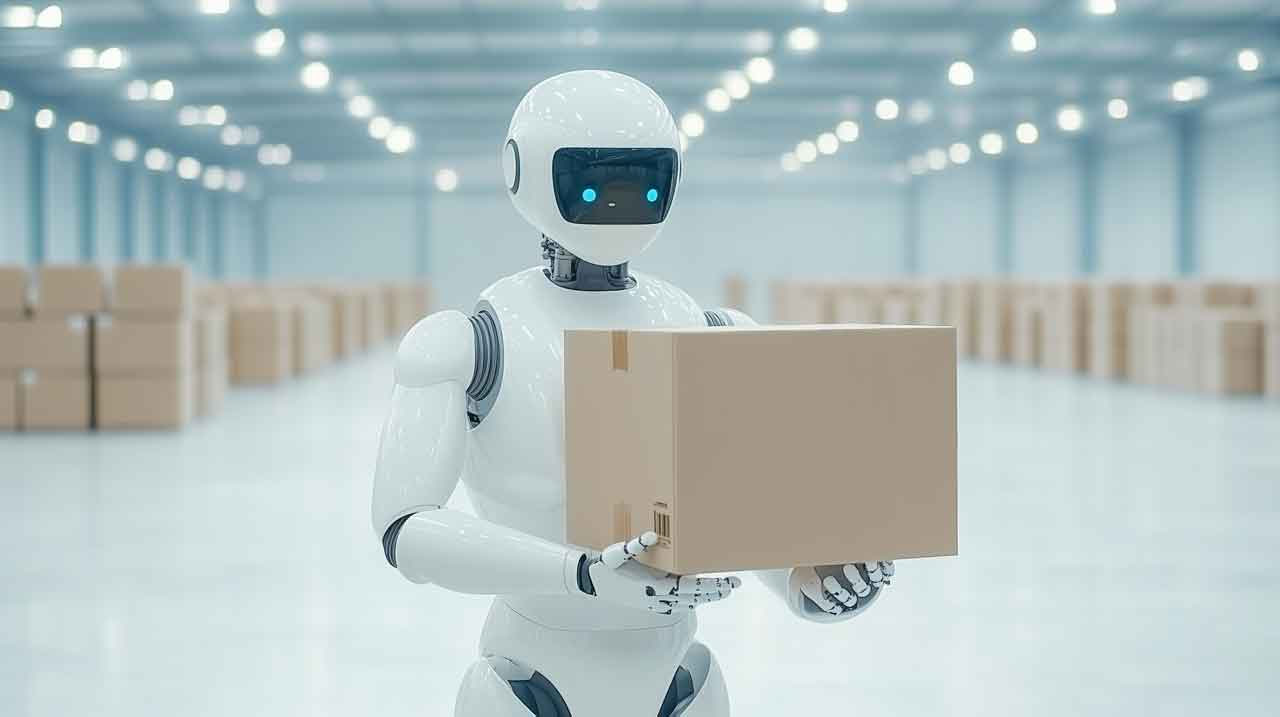
Intralogistics has been and remains a driver of industrial automation. Intelligent warehouse technology, robot-assisted systems, and driverless transport vehicles define the image of modern logistics centres. Swift and simple integration of heterogeneous systems, processes, and technologies is crucial. Operators of logistics centres and manufacturers of automation solutions respond to a fast-moving logistics world in which resilience means reacting quickly and adapting one’s own processes and structures. With the market entry of humanoid robots, a automation embarks on a new era. They are more than just another form of existing automation technology. They follow a new paradigm: traditional automation solutions take over predefined functions in structured process environments and are designed for maximum performance in a specific task. By contrast, humanoid robots embody the ideal of multi-purpose robotics, i.e. the flexible, needs-based execution of various tasks, including those previously reserved for humans. In consequence, they operate in open, dynamic work environments, taking on different tasks in changing contexts. This fundamentally changes the requirements for integration.
Not “if”, but “when”
A recent study by Fraunhofer IML reveals that companies worldwide are actively developing humanoid robots that, according to current product claims, are feasible to be deployed in logistics. The researchers identified more than 80 systems in a market survey; the study presents a dozen of them. A complementary industry survey showed that, although humanoid robots are not yet in productive use at any company, most enterprises expect deployment within the next four to ten years. Thus, the question is no longer whether humanoid robotics will be used in intralogistics, but when and under what integration conditions.
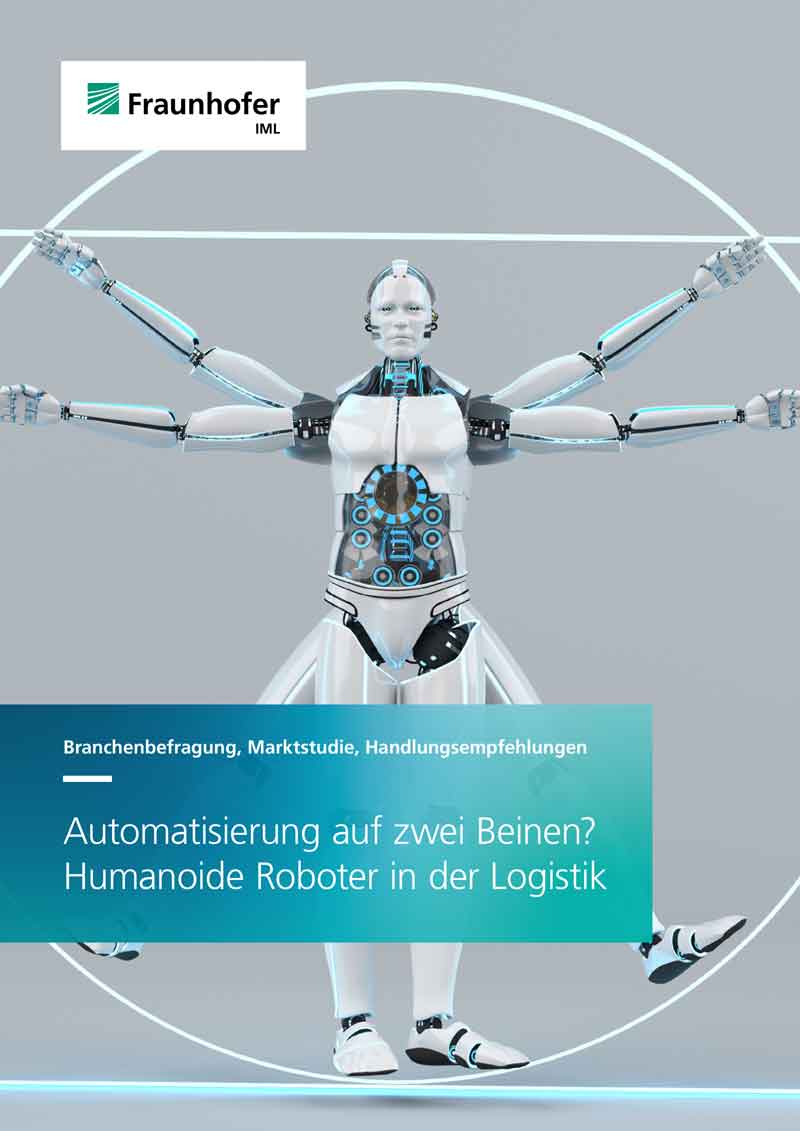
The new Fraunhofer IML study is entitled “Automation on Two Legs? Humanoid Robots in Logistics”. It presents the results of a detailed industry survey and an international market study. From these insights, Fraunhofer IML derives recommendations for action for companies, researchers, and policymakers.
Hardware development is currently concentrated in the USA and China. So far, Europe is represented sporadically. However, integration nonetheless concerns European companies. To operators of warehouses and distribution centres, the integrability of the new generation of robots into existing systems directly affects productivity, scalability, and economic efficiency.
In highly automated environments, physical material flow is inseparable from ERP, WMS, and control systems. Any additional technology that cannot be seamlessly integrated into this architecture reduces the transparency necessary for decision-making, increases complexity, and creates new interfaces. European users, logistics service providers, and system integrators who will incorporate humanoid robots into their portfolios face similar challenges. Robots from different manufacturers each come with unique navigation concepts, data models, and communication protocols. Each new system combination, therefore, results in project-specific integration solutions.
This was already observed several years ago with the introduction of driverless transport vehicles in intralogistics. In 2017, the German Association of the Automotive Industry (VDA) and the Specialist Association for Conveyor Technology and Intralogistics of the German Engineering Federation (VDMA) therefore initiated a communication interface for the development of an open standard: VDA 5050, a manufacturer-independent, standardised communication between driverless transport vehicles, autonomous mobile robots (AMRs), and central control systems, enabling operators of logistics and distribution centres to run mixed fleets of different types of robots. The open source software libvda5050++, developed at Fraunhofer IML in 2021 and published in the Open Logistics Repository of the Open Logistics Foundation, provides an open source solution that serves as the technical implementation of the standard and can equip almost any driverless transport vehicle for the VDA 5050 standard.
Opportunity for Europe
The more diverse and universal the fields of application for robotics become, the greater the need for shared, open integration foundations. In the context of humanoid or multi-purpose robots, it is not just about communication, but about modelling basic logistics functions, standardised process descriptions, and interoperable data models that allow flexible task allocation between humans and robots. Open standards and open source components for non-competitive areas provide users and integrators with the opportunity to focus development resources on performance features that differentiate them, rather than repeatedly solving interface problems on a project-by-project basis. Operators benefit because they can integrate new robotics faster and with lower risk into existing structures.
Especially against the backdrop of global hardware dynamics outside Europe, this presents an important opportunity. If it is possible to further develop the integration and software architecture of intralogistics on open, shared foundations, Europe can strengthen its competitive position in logistics in a sustainable fashion.
“In intralogistics, many fundamental terms such as pick, order picking, retrieval, or packing have so far been interpreted differently, resulting in processes being implemented inconsistently. The introduction of humanoid robotics now emphasises the need for both operators and manufacturers to standardise definitions and procedures. To ensure processes are implemented consistently and productively, uniform standards that benefit everyone are now essential for greater efficiency and lower costs. Against this background, I can very well imagine operators and manufacturers working together on this in a Working Group on Intralogistics within the Open Logistics Foundation and in corresponding projects.”
Christian Prasse, Head of Strategy, Fraunhofer IML
About the author
Prof. Dr.-Ing. Alice Kirchheim is an expert in intralogistics, with a focus on the planning and design of warehousing and order picking systems, the automation of logistics processes, and the use of AI. Since April 2024, she has been Director of the Fraunhofer Institute for Material Flow and Logistics IML and holds the Chair of Material Handling and Warehousing at TU Dortmund University. Fraunhofer IML is a founding member of the Open Logistics Foundation; Alice Kirchheim is Chair of the Board of Open Logistics e. V., the Foundation’s supporting association.