
Collect. evaluate. develop.
Turning members’ ideas into action

Step by step: Navigating the Ideation Process
The Open Logistics Foundation’s Ideation Process provides a structured yet flexible framework to collect, evaluate and develop ideas collaboratively across companies. The entire process is supported by the Foundation’s Head Office.

1. Idea submission
The Open Logistics Foundation (OLF) is member-driven, meaning that project ideas are initiated directly by the member companies. There are several ways to contribute.
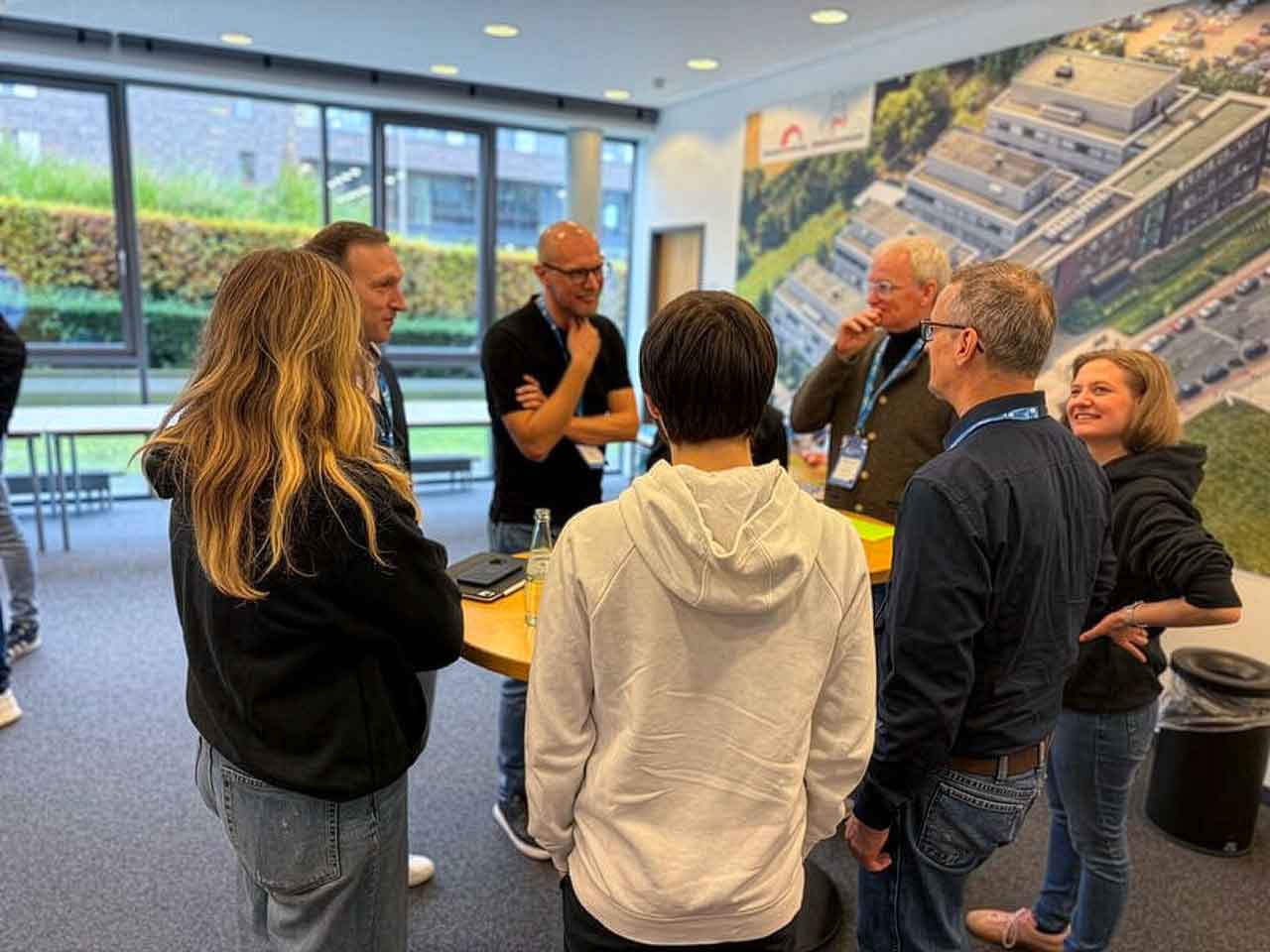
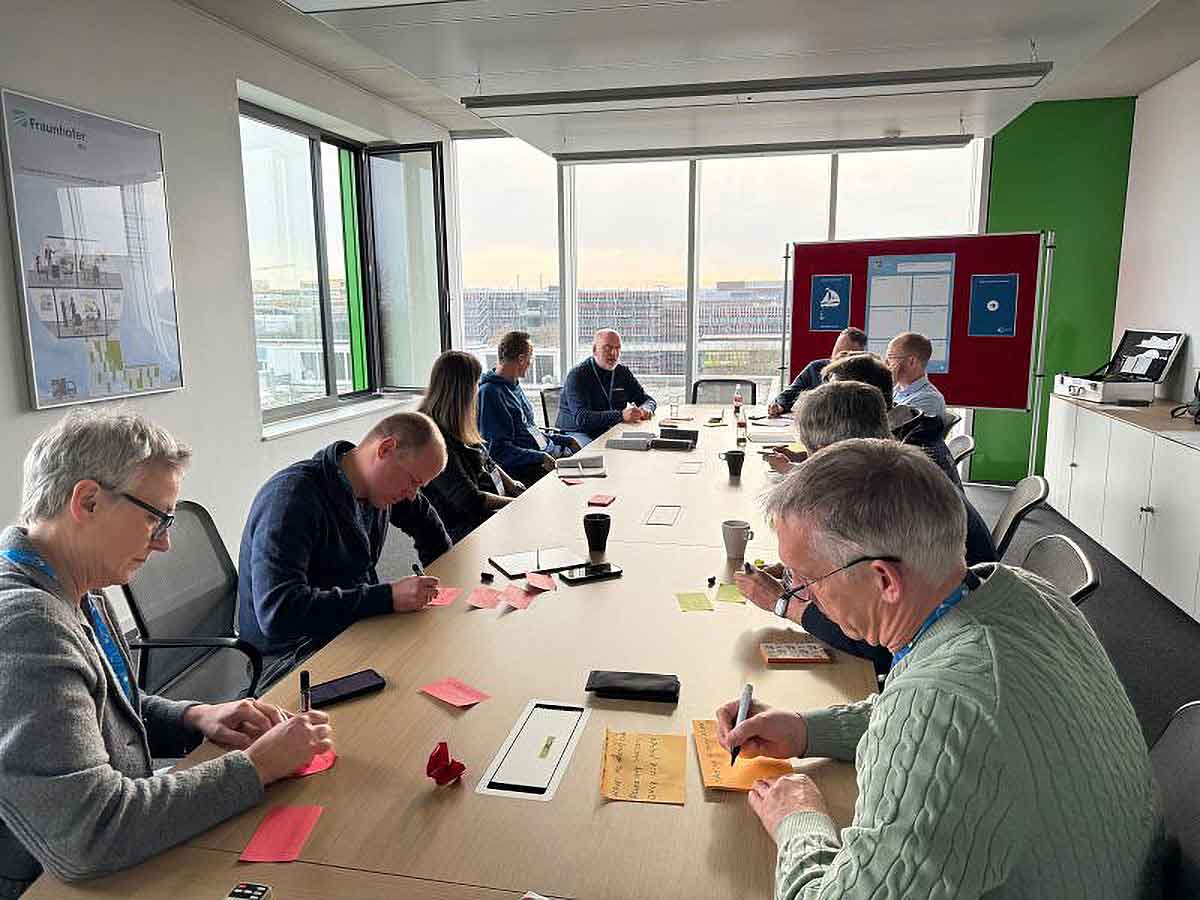
- Ideation Workshop: The annual in-person Ideation Workshop, typically held at the end of the year, is a valuable starting point for introducing ideation topics and finding like-minded representatives from other companies.
- Direct contact with the Head Office: Members can approach the OLF Head Office at any time to propose new topics or discuss existing ideas.
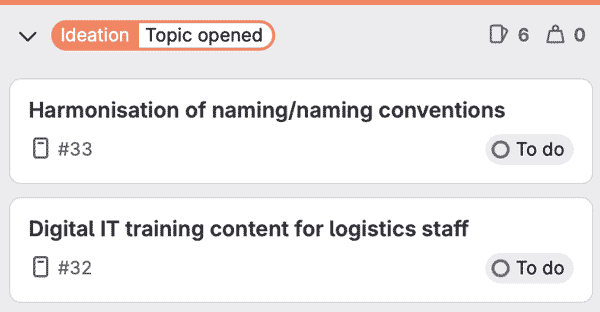
- Idea Collection Board in GitLab: Members can submit topic ideas at any time via the Git Repository. All contributions are collected there, visible to interested parties, and added to the pool of ideation topics for discussion.

2. Idea screening
The OLF Head Office collects ideas as they are submitted, and then gauges member company interest through a poll. Members can respond to that poll or reach out directly to share their particular interest.

3. Idea evaluation
Once several companies express interest, the idea is assessed for feasibility within the OLF framework. This evaluation is guided and ultimately ranked by the members of the Logistical Steering Committee (LSC), based on a defined set of criteria.
Interest of member companies
- At least two companies must be interested
- At least one company should be willing to act as the potential industry lead
Feasibility
- Does the topic have a sufficient commodity character?
- Does it make sense, and is it feasible, to implement the idea jointly under the OLF umbrella?
- Are there very similar solutions available on the market?
Relevance to the logistics sector
- Is this relevant to my organisation?
- Is this relevant to the entire logistics sector?
Partner resources
- What is the potential benefit and value for the partner companies?
- How committed are the stakeholders to the idea, and how engaged are they?
- Are stakeholders willing to invest the necessary resources, such as time, money, manpower and technology?

4. Idea workshops
If an idea meets the criteria, it is further developed in dedicated virtual workshops. These workshops follow the principles of Design Thinking – an iterative, creative and solution-oriented approach where companies collaborate as equals.
The workshops’ format and phases are flexible. The goal is to clarify and concretise the new ideas, build a shared understanding of the problem, and, where appropriate, develop a Minimum Viable Product (MVP) to make ideas more tangible.

5. Project approval
The new idea is either approved as a new project or returned to idea pool for further refinement and consideration.

6. Project integration
The idea transitions into a new project and is integrated into an established Working Group.
If no suitable Working Group exists, then one must be formed. The LSC steps in again to support this process.
Specific conditions must be met to ensure a Working Group’s success and continuity.
- Commitment from member companies: At least one company takes on the role of Working Group lead, and at least two additional companies must actively participate. The Working Group lead is not solely responsible for the project’s execution. Instead, they act as subject-matter expert, driving progress and co-moderating the Working Group together with the OLF Head Office.
- Clear definition of objectives: Goals must be clearly defined, with a distinction between commodities (standardisable solutions) and market-differentiating aspects.
If approved, the newly defined Working Group is established and the new project is integrated into it.
Meeting grounds for members
Generating ideas, deepening expertise: the Open Logistics Foundation’s member formats create dedicated spaces for open exchange, inspiration, and meaningful networking among peers.

Ideation Workshop
The Ideation Workshop is the central space for creative collaboration within the network. Members contribute ideas, explore different perspectives, and develop approaches together. Here, inspiration evolves into viable concepts, refined through collective expertise and put into action.

Open Source Innovation Days
The Open Source Innovation Days are where we bring in new inspiration and broaden our perspective beyond the network itself. Here, members can stay informed about current industry developments, gain insights from the open source world, and discover new topics.
Get in touch.


Nathalie Böhning
Innovation and Project Management
+49 (0) 152 02347913