
At first glance, it sounds like a contradiction.
Why would a global software company, whose success is built on innovation, intellectual property, and differentiation, invest time, resources, and senior attention into open source initiatives? Why would a company like Blue Yonder — serving some of the world’s most demanding supply chains — actively support the creation of open, shared industry standards?
The answer is simple, and at the same time deeply strategic:
Because our success depends on the success of our customers — and our customers can only truly outperform in an industry that works together where it matters most. One year ago, Blue Yonder joined the Open Logistics Foundation. Looking back today, it is clear: this decision was not only right. It was necessary.
Customer excellence comes first
Blue Yonder’s primary mission has always been clear: enable customers to be excellent and outperform — in service, efficiency, resilience, and sustainability.
That is how we create value.
That is how long-term partnerships are built.
And that is how sustainable growth happens—on both sides.
To achieve this, Blue Yonder invests massively in proprietary capabilities:
- Advanced optimisation algorithms
- AI-driven planning and execution
- Deep industry-specific process models
- Integrated end-to-end decision intelligence
These are areas where differentiation matters. Where competitive advantage is created. Where customers win or lose in the market. But there is another category of capabilities — just as critical — where differentiation makes no sense at all.
Where open beats closed
There are parts of logistics where the highest value is created when everyone speaks the same language.
Standards for documents.
Standards for handovers.
Standards for appointment booking.
Standards for status exchange.
Standards for reporting.
In these areas, fragmentation does not create competition. It creates waste:
- Endless bilateral integrations
- Manual workarounds
- Misunderstandings and mismatches
- High coordination effort
- Constant firefighting
We are not competing on PDFs and phone calls. But we are spending an incredible amount of time on them.
This is exactly where the Open Logistics Foundation comes in.
One year in: From idea to impact
When Blue Yonder joined the Open Logistics Foundation a year ago, the vision was clear: build a coalition of the willing to create open, practical, implementable standards for real logistics processes.
The progress since then has been remarkable.
eCMR: A Digital Foundation for Everyone
The electronic consignment note (eCMR) is a perfect example.
Instead of every company and every country developing its own interpretation and interface, the foundation has created a shared, open standard that:
- Works across systems
- Works across companies
- Works across borders
The result is not just less paper. It is less friction in the entire ecosystem.

Learn more about the OLF-eCMR solution.
Timeslot booking: Attacking one of logistics’ biggest sources of waste
Another powerful example is the Timeslot Management project. Today, a shocking amount of operational effort is wasted on:
- Coordinating arrival and departure times
- Chasing confirmations
- Handling last-minute changes
- Resolving conflicts manually
It is slow. It is expensive. And it is completely unfit for a digital supply chain. The Open Logistics Foundation is creating a shared standard that allows enables all participants — shippers, carriers, warehouses, and platforms — to use the same language and the same logic.
And this is where it becomes truly strategic.
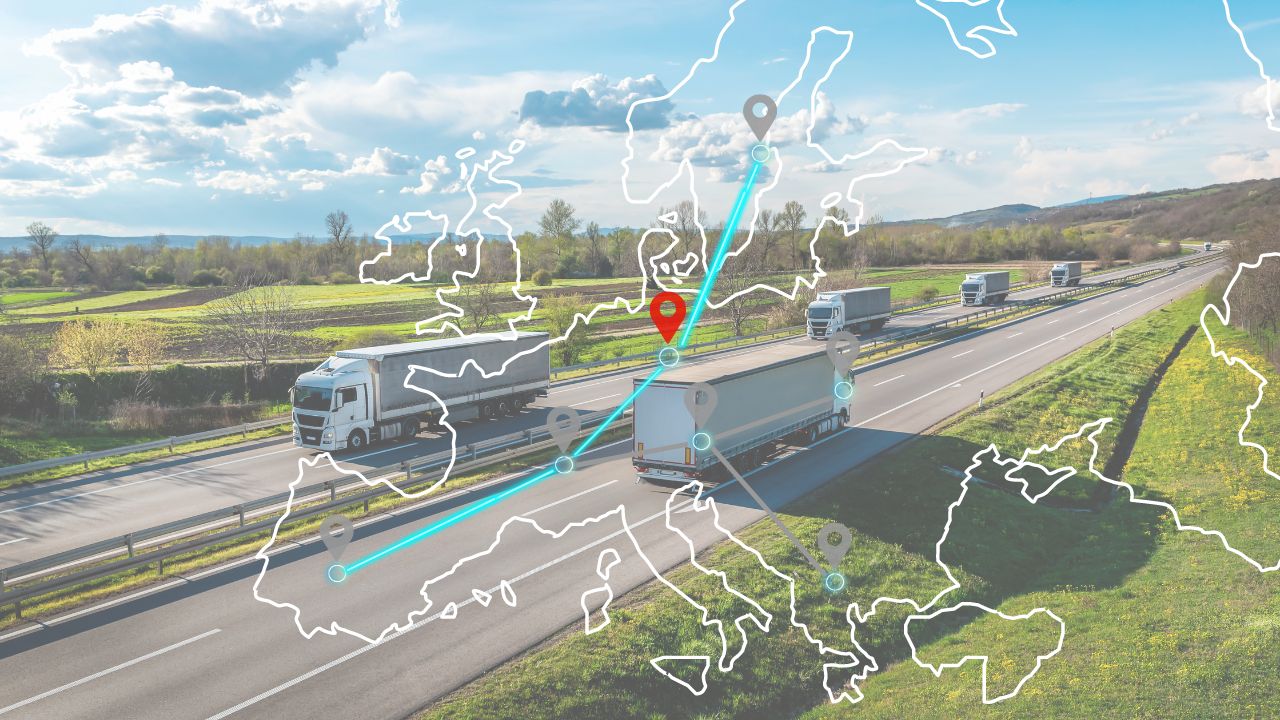
Learn more about the Timeslot Management project.
Once time windows are standardised and machine-readable, Blue Yonder’s network can interactively communicate, and planning systems can start to negotiate them dynamically, says Robert Recknagel, Vice President at Blue Yonder. Imagine a fleet management or transportation planning system that can optimise routes and schedules while interacting in real time with warehouse slot availability. That’s not just automation — that’s a completely new level of system intelligence. Our customers don’t buy Blue Yonder because of our proprietary document format. They buy us because we help them run their supply chains more efficiently. Open standards make the ecosystem faster, cheaper, and more reliable — and that makes our customers more successful.
Network effects beat individual optimisation
There is another, even more important aspect. Logistics is not a single-company game. It is a network sport.
The best planning system in the world still depends on:
- Partners
- Carriers
- Terminals
- Authorities
- And many other participants
Open standards multiply the value of digitalisation:
- Each new participant increases the benefit for everyone
- Each new adoption reduces friction for all others
- Each shared interface replaces dozens of custom ones
This is how real scalability is created.
Looking forward: An invitation
After one year, the conclusion is clear: this journey has only just begun.
Blue Yonder is ready to continue investing, contributing, and leading — as one of the global players in supply chain software. And we hope many more will follow. Because in the end, this is not about open source versus proprietary. It is about something much more important: enabling customers to outperform in an industry that finally works as one.